
Florida Just Voted to Torch the HOA — and It's About Damn Time
Nearly half of Florida lives under HOA rule. A lot of them have been living under something closer to extortion. Florida has 49,000 homeowners associations. Nearly half the state's population — about 9.6 million people — wakes up every morning governed by one.
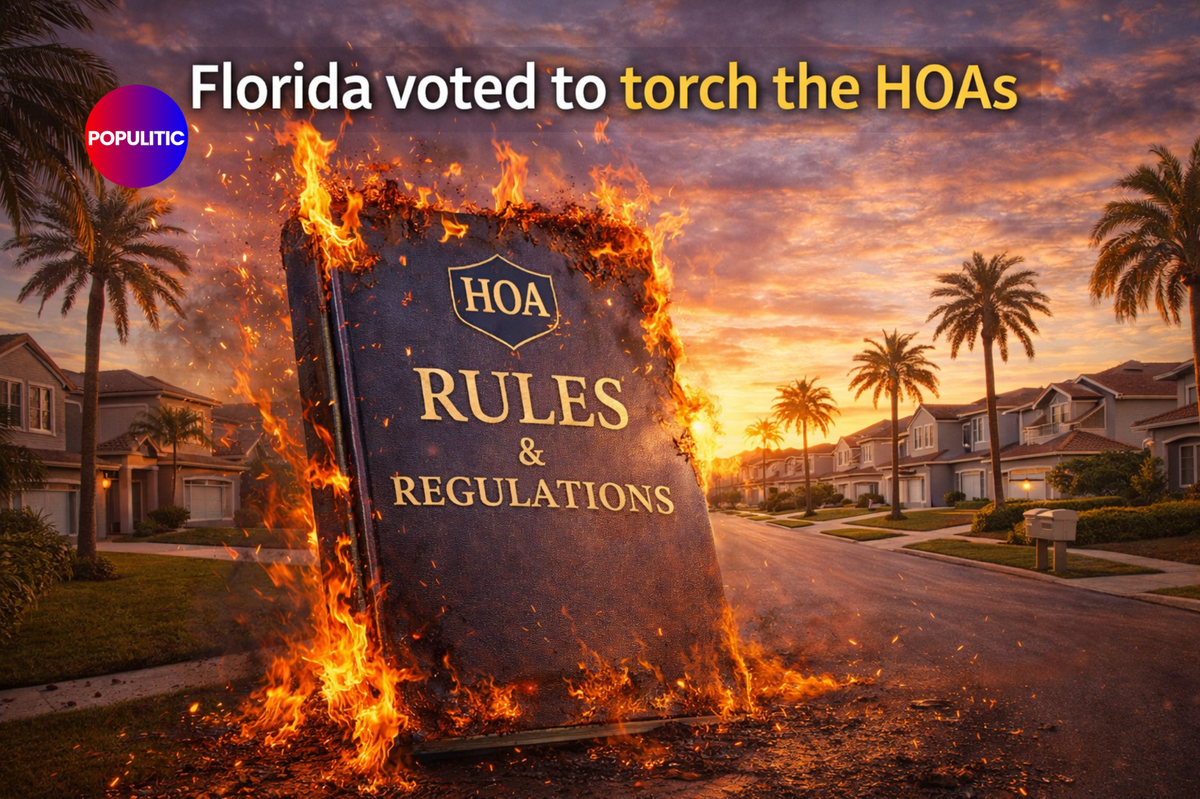
Nearly half of Florida lives under HOA rule. A lot of them have been living under something closer to extortion.
Florida has 49,000 homeowners associations. Nearly half the state's population — about 9.6 million people — wakes up every morning governed by one. That's more HOAs than any other state in the country, which means Florida also leads the nation in HOA fraud, HOA abuse, and HOA boards that behave less like neighborhood management and more like a local crime syndicate with a clipboard.
This week, the Florida House said enough.
House Bill 657, sponsored by Miami Republican Rep. Juan Carlos Porras, passed 108 to 2. That's not a vote. That's a verdict. The bill creates a dedicated Community Association Court to handle disputes directly — no more expensive pre-lawsuit mediation that mostly benefits HOA attorneys. It tightens conflict-of-interest rules. It creates criminal penalties for board members who hide financial records. And for the first time in Florida history, it gives homeowners a legal mechanism to do what many of them have been dreaming about for years: dissolve the HOA entirely.
Porras didn't sugarcoat it. He called HOAs "a failed experiment." He said they have "run amok" through wide regulatory loopholes. He said an HOA board president today is more powerful than a Florida state representative.
He's not wrong.
Why this happened
Because “community standards” turned into community hostage situations in a lot of neighborhoods.
Lawmakers are reacting to years of resident complaints that HOA boards can:
- slap on fines like they’re handing out flyers,
- place liens that escalate fast,
- weaponize enforcement selectively,
- and leave homeowners with a dispute process that feels like arguing with a wall… that also charges late fees.
The sponsor even summed it up with the kind of line you only say when you’ve heard enough horror stories: homeowners having “absolutely no recourse” for unnecessary fines and liens — even losing their homes.
The “historic fraud and abuse” part everyone pretends is rare (it’s not)
Florida didn’t wake up one day and randomly decide to bully HOAs. This push has fuel — including high-profile cases where HOA leadership has been accused of straight-up theft and organized schemes.
One of the most infamous examples is a massive HOA in Miami-Dade (The Hammocks) in West Kendall. the largest HOA in Miami-Dade County, covering over 40 communities and 18,000 residents — was quietly being looted by its own board. Former HOA president Marglli Gallego and a network of board members, relatives, and vendors constructed an elaborate fraud scheme: fictional companies, fake vendor payments, and checks signed for hurricane cleanup work after a hurricane that never made landfall. Over 8 people were eventually arrested. Residents watched their HOA fees spike by 400 percent. Some were paying nearly $500 a month for a one-bedroom condo. The reserve funds were drained. A court-appointed receiver had to step in to manage the fallout. Total misappropriation: potentially between $12 and $13 million, according to residents who watched it happen in real time.
Racketeering. Money laundering. Organized fraud. Miami-Dade State Attorney Katherine Fernandez Rundle said the quiet part out loud: these are terms we normally associate with drug cartels — not HOA boards in southwest Miami-Dade.
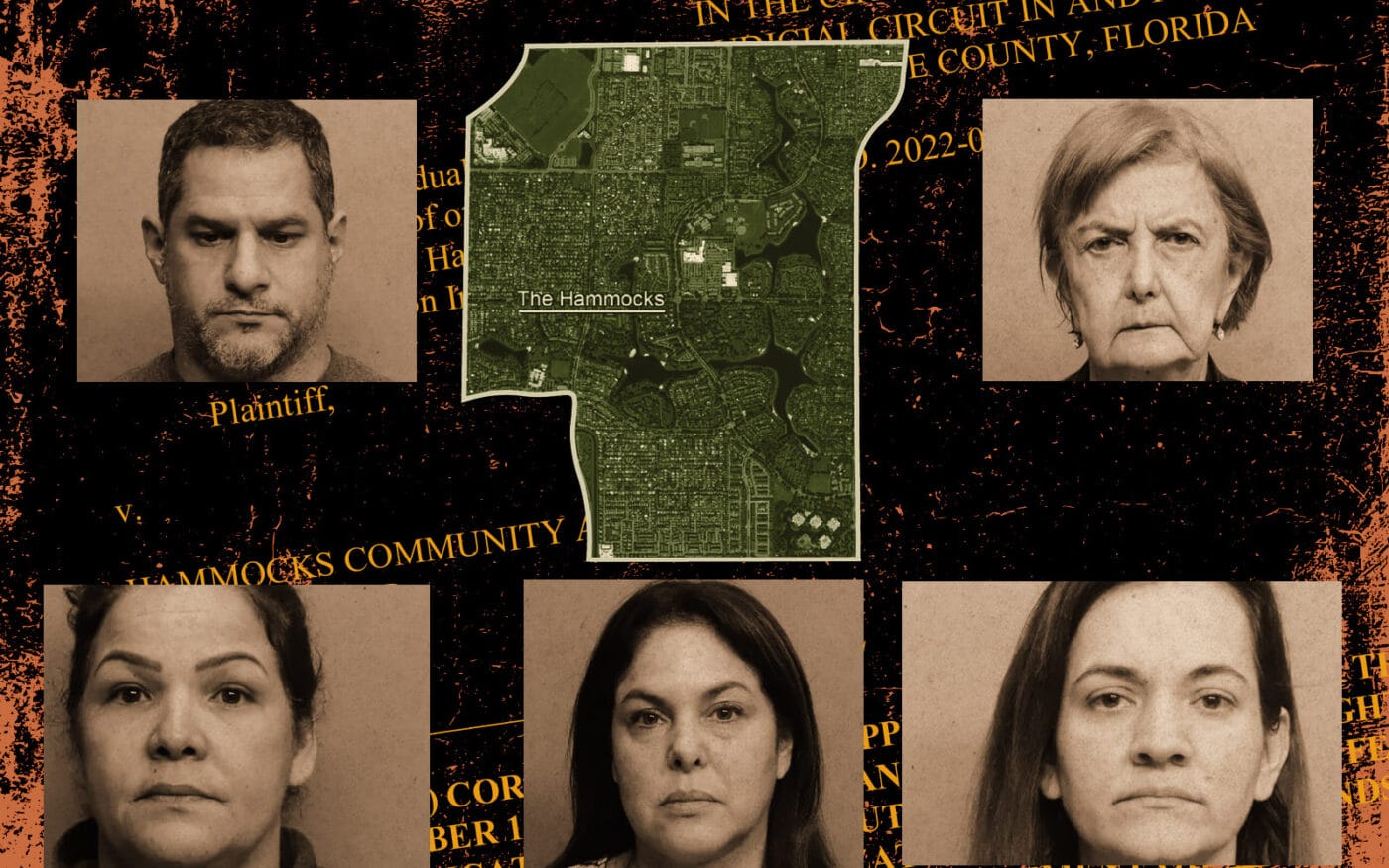
And The Hammocks is not an outlier. It is a case study.
A woman in Central Florida paid her HOA dues and was still threatened with foreclosure — on a debt she didn't owe — because the check went to the wrong law firm. It took a federal lawsuit and two years of her life to resolve. A Palm Beach Gardens HOA treasurer stole nearly $58,000 by cashing association checks to herself. A Seminole County HOA manager embezzled $437,000. A former Largo woman received eight years in prison for stealing $1 million from HOAs she managed. Across Florida, HOA boards have handed family members million-dollar vendor contracts for work that was never done, suspended residents' voting rights over minor fee disputes, filed bogus code violations against homeowners who spoke up, and used foreclosure as a weapon against people whose only crime was being late on a check.
The HOA industry has quietly grown into a $38 billion sector. That money doesn't manage itself — and not everyone managing it has been doing so honestly.
That’s not “oops, we misfiled a receipt.” That’s “this is why people don’t trust the board with a checkbook and unchecked power.”
What the House bill actually does (aka: why HOA boards are nervous)
This package isn’t just “be nicer.” It builds tools that can actually hurt:
1) A real HOA dissolution path
The bill creates a “Dissolution and Accountability” framework that lets parcel owners start the process with a petition signed by 50% of voting interests — and requires approval by two-thirds of total voting interests to terminate the HOA under the plan.
Also: once dissolved, the HOA’s recorded governing docs are treated as terminated and unenforceable, and the clerk marks them as inactive.
Translation: the HOA can’t haunt you from beyond the grave.
2) A specialized court-style program for association disputes
The bill calls for a community association court program structure and reporting requirements — basically moving disputes into a more formal, trackable lane instead of the usual “good luck, see you in mediation” routine.
3) Loyalty and conflict-of-interest rules
It creates a duty of loyalty for HOA directors/officers/committee members and defines conflicts of interest — including a presumption of conflict if the association is compensating or contracting with a director/officer/committee member or their immediate family.
4) Records with teeth
It tightens what counts as “financial statements” in official records, including bank statements and even copies of check images for disbursements.
It also requires quicker production of records to law enforcement/prosecutors — and makes willful failure a misdemeanor.
Translation: “Show us the money” becomes less of a request and more of a requirement.
Why this changes Florida’s financial landscape
If this becomes law, it will shift power — and money.
- More litigation and disputes—at first. When you give homeowners sharper tools, they use them.
- More pressure on association finances. Better records + conflict rules = less room for “creative accounting.”
- More risk for bad boards, more stability for good communities. HOAs that run clean won’t fear transparency. HOAs that run like a private kingdom? Different story.
- Real estate ripple. Buyers care about HOA governance. Clearer enforcement and accountability can change how communities are valued and marketed.
Final take
Florida’s message to HOA boards is basically:
“Congratulations, you’re still in charge… but now you’re supervised.”
And to homeowners? It’s:
“Stop writing angry emails. We’re giving you actual leverage.”
If you’ve ever paid a fine for a mailbox, a shrub, a paint shade, or “approved holiday decor hours,” you know exactly why this vote happened.
The only question now is whether the Senate lets the match hit the gasoline… or quietly slides the can back under the shelf.
Comments ()