
Marco Rubio Slams the N.Y. Times for Cuba Misinformation.
Every time the legacy media even whispers the words “Cuba” and “negotiations” in the same sentence, two things happen immediately: Havana starts acting like it just discovered capitalism (but only the parts with hard currency). Miami starts reading between the lines like it’s a telenovela finale.
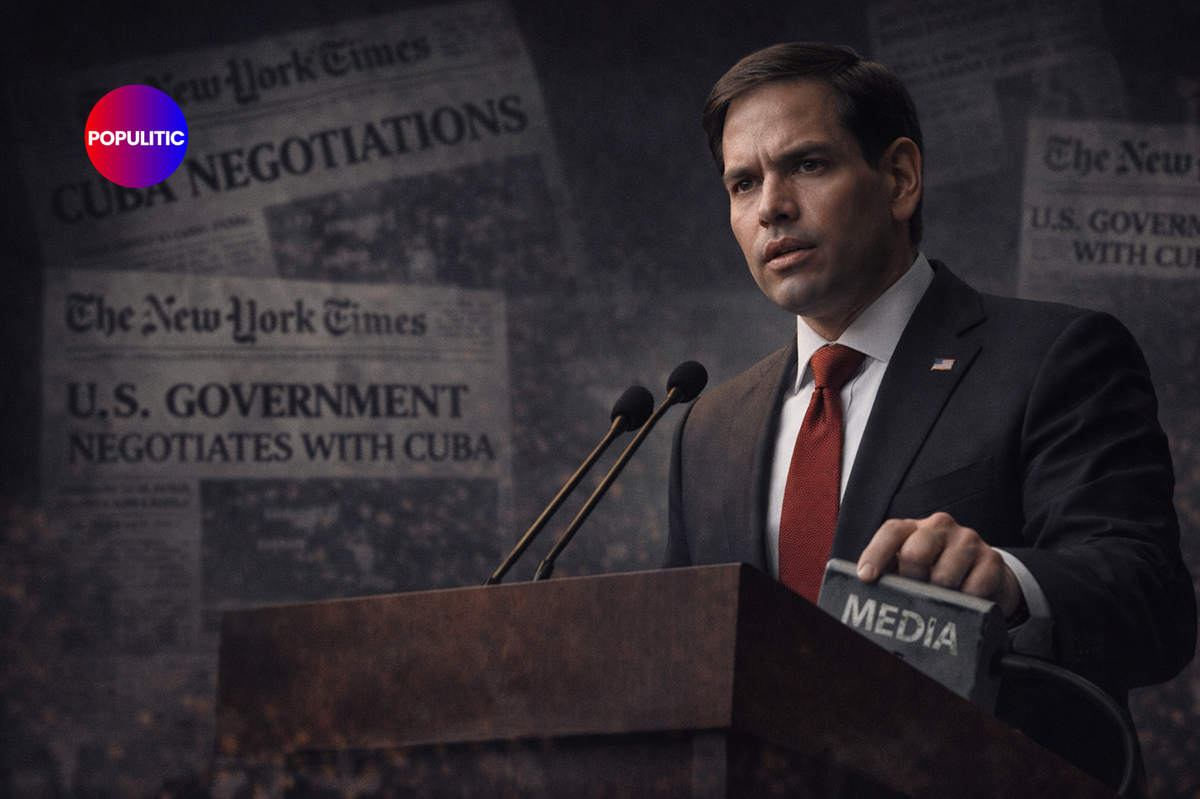
Every time the legacy media even whispers the words “Cuba” and “negotiations” in the same sentence, two things happen immediately:
- Havana starts acting like it just discovered capitalism (but only the parts with hard currency).
- Miami starts reading between the lines like it’s a telenovela finale.
This week’s episode: a major national paper reported that U.S. officials told Cuban negotiators that real progress requires Miguel Díaz-Canel to step aside—a claim sourced to four people familiar with the talks.
Secretary Marco Rubio’s response was not “no comment.” It was closer to a flying elbow drop.
He publicly called the story fake, and he didn’t just deny it—he attacked the idea that anonymous “in-the-know” sources deserve automatic credibility. In Rubio’s version, too much media coverage is built on “charlatans and liars” pretending they’re plugged into high-level diplomacy.
And then the paper’s spokesperson essentially fired back: we stand by the reporting and said they sought comment before publication. Which basically means, we asked, no one said anything, so we published whatever we wanted.
Miami got what it always gets: a familiar feeling that somebody is trying to sell a “transition” without actually changing the system.
The part people in Miami catch instantly
Even in the reporting that Rubio is rejecting, the “big ask” wasn’t a full dismantling of the regime—it was a leadership swap framed as a path to economic changes and negotiations, while the reporting suggested the U.S. wasn’t pushing action against the Castro family (as described in recaps of the article).
That’s exactly why this blew up.
Because Miami doesn’t confuse the face of power with the structure of power. Díaz-Canel is the front desk. The building is the problem.
Rubio’s message: “cosmetic change” isn’t freedom
At the same time this dispute is playing out, Rubio has been blunt about what he thinks Cuba needs: dramatic change, not economic tweaks announced during blackouts. In recent remarks, he said Cuba’s system “doesn’t work” and “they have to change dramatically,” and that what Havana announced was “not dramatic enough.”
That’s not a negotiation vibe. That’s a pressure vibe.
And Rubio—especially as a Cuban American—has made clear he’s not interested in a “rebrand” of the dictatorship. His broader regional posture has emphasized transnational criminal threats, narco-trafficking networks, and terror-linked actors as national security issues.
The real issue isn’t the headline — it’s the temptation
The temptation in foreign policy is always the same: declare progress because progress looks good on paper.
- “We’re talking.”
- “We’re making headway.”
- “We’re seeing movement.”
But the Cuban people don’t live on press releases. They live on ration lines, blackouts, censorship, political prisons, and an economy that treats normal life like a privilege tier.
So if Washington’s “solution” is just swapping one official for another while keeping the machinery intact, then that’s not a transition. That’s interior decorating.
The Takeaway
Rubio didn’t just deny a story. He denied the entire genre of story: the one where anonymous whispers become “policy,” and where Cuba’s dictatorship gets to cosplay as a normal government because it agreed to talk.
If you’re going to negotiate, negotiate for something real:
- real political freedom
- real civil rights
- real releases of political prisoners
- real openings that don’t funnel money straight back into regime control
Because the Cuban people don’t need a new face on the podium. They need the podium removed.
The Fact!
For 67+ years, Cuba has lived under a system built on control—control of speech, control of movement, control of opportunity, control of truth. A generation was told to wait. Another was told to leave. Another learned to survive in silence.
But history doesn’t stay frozen forever.
What’s happening now—pressure, scrutiny, exposure, and the world finally refusing to romanticize repression as “stability”—isn’t just political noise. It’s the early sound of something breaking loose.
Because real stability in the Caribbean won’t come from pretending the dictatorship is permanent. It will come from the opposite: a free Cuba—one where citizens can speak without fear, build without permission, travel without punishment, and vote without theater.
And when that day comes, it won’t just change Cuba. It will change the entire region:
- less forced migration driven by desperation
- less black-market survival economy feeding criminal networks
- less geopolitical leverage for hostile actors
- more legitimate trade, investment, and opportunity across the Caribbean basin
That’s the real “deal” worth pursuing—one that replaces repression with legitimacy and fear with normal life.
The Cuban people deserve their Berlin Wall moment—but this time in the Caribbean—and when it finally falls, it won’t be chaos. It will be relief. It will be renewal. And it will be the beginning of the most powerful kind of stability there is:
the stability that comes from FREEDOM.
Comments ()